A Beginner's Guide to Collecting Vintage Brooches: Styles, Materials and Hallmarks
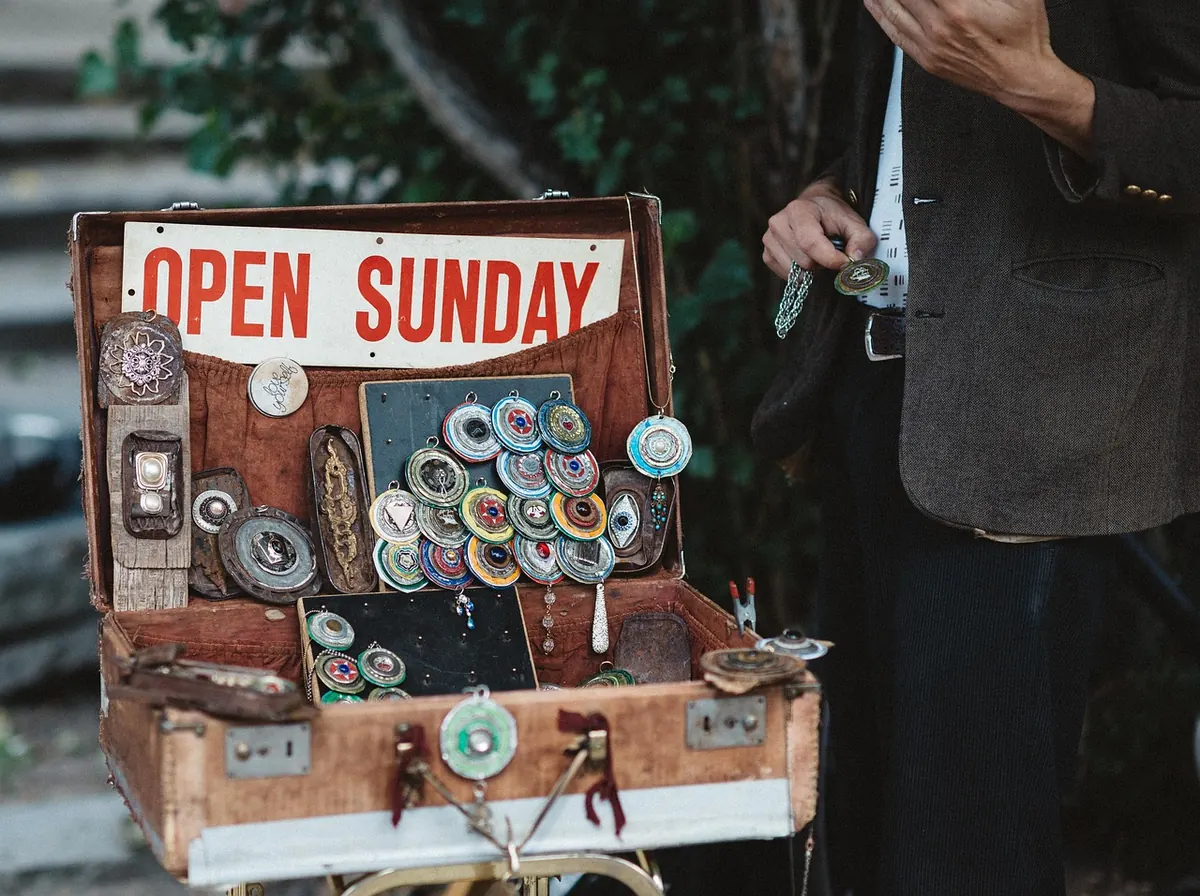
A brooch is the most forgiving piece of jewellery you can collect. It does not have to fit, it does not need a pair, and it works as well on a wool coat as on a silk scarf or the shoulder of a plain jumper. That makes it the ideal entry point for anyone curious about vintage: you can spend very little, learn a great deal, and end up with something you will actually wear. The trick is knowing what you are looking at when you turn a piece over in your hand.
The Eras at a Glance
Brooch design moves quickly, and the clues are usually visual before they are technical. Learn a handful of silhouettes and you can place most pieces within a decade or two.
- Victorian (1837–1901): jet and black glass mourning pieces, cameos, sentimental motifs such as hearts, clasped hands and forget-me-nots.
- Art Nouveau (roughly 1890–1910): whiplash curves, peacock-coloured enamels, female faces framed by flowing hair.
- Edwardian (1901 to just before the First World War): light, lacy metalwork, bows, garlands, pearls and diamonds set in platinum or silver-topped gold.
- Art Deco (1920s–1930s): geometry, fans, sunbursts, black and white, bold colour blocking, long slim bars.
- 1930s–1950s costume jewellery: pot metal and brass set with rhinestones, big enamelled flowers, figural pins. This is the great age of the signed piece.
- 1960s–1970s: plastics, matte gold-tone metal, abstract and mod shapes, wood, leather and craft-revival work.
Two cautions. Eras overlap rather than snap shut, and revivals are everywhere — the 1960s borrowed from Art Nouveau, the 1980s from Victorian and Deco. Treat style as a starting point, then confirm it with materials and fastenings.
Materials: What You Are Really Looking At
Paste, rhinestones and diamanté
Most costume brooches are set with glass, and that is not a fault. Victorian paste was lead glass, cut by hand and backed with foil to make it flash. That foil is the weak point: it clouds and lifts with age, and water will finish it off, so never soak a foiled stone. The word diamanté simply describes this effect. From the 1930s onward, rhinestones were prong-set into pot metal or brass. Prongs suggest an older or better-made piece; glued stones are cheaper to produce and far harder to replace neatly.
Plastics and early synthetics
Celluloid, Bakelite and later Lucite gave designers colour without weight or cost. Bakelite feels warm and dense in the hand and gives a dull clack rather than a bright ring when tapped. The hot-water smell test is widely repeated but unreliable, and it can damage a piece — judge by weight, warmth and the crispness of the moulding instead.
Enamel
Cloisonné, champlevé, guilloché and plique-à-jour all appear on brooches, and all chip. Look along every edge under good light. Small nibbles at the rim are common and forgivable; a large missing patch is not, because re-enamelling convincingly is skilled, expensive work.
Metals and stone substitutes
Expect brass, pot metal (a zinc alloy), japanned black metal, gold-filled or rolled gold, and sterling silver. Sterling pieces are more often signed. Gold-filled metal has a layer of gold bonded to a base core and wears far better than plating, which rubs through at high points. Marcasite is usually pyrite; French jet is glass, not jet; and much of the coloured glass on early pieces is Bohemian or Czech.
Back Marks, Fastenings and Other Clues
Turn every brooch over before you fall for the front. The reverse tells you more than the face does.
Catch types
- C-clasp: a simple hook, common from Victorian times into the 1910s.
- Trombone or sliding clasp: a tube that slides over the pin, strongly associated with the Art Deco period.
- Roll-over safety catch: the workhorse from the 1920s onward, still used today.
- Modern locking catch: a firm mechanical snap, typical of later mass-produced pieces.
On older brooches the pin stem usually extends a little past the catch; on newer ones it tends to stop short. A replaced pin, a blobby solder joint or a catch in a different metal colour all point to repair.
Reading the marks
A signature is a maker's mark, not proof of age, and marks can be added later. Still, they help enormously. Coro and Corocraft, Trifari, Napier, Boucher, Eisenberg, Weiss, Kramer, Lisner, Monet, Sarah Coventry and Swarovski all signed their work, as did Dior and Chanel. Country marks are just as useful: a piece stamped Czechoslovakia was made between 1918 and the early 1990s, while Made in Austria or Germany narrows the field further. Plenty of good brooches are unsigned, so an absence of marks means nothing on its own.
How to Buy With Confidence
Buy in person where you can, and give every piece a two-minute inspection.
- Check the pin stem is straight, the hinge firm and the catch secure.
- Shine a torch across the stones. Dull, grey or cloudy ones have lost their foil; mismatched replacements stand out immediately.
- Look for glue bloom around settings and any stone sitting proud of its neighbours.
- Inspect enamel rims for chips and crazing.
- Check crevices for green verdigris. It cleans off, but it signals base metal underneath.
- Weigh it in your hand. Heavier pieces are usually better made than thin stamped ones.
- Ask whether anything has been repaired, and expect an honest answer to affect the price.
Cleaning and Storing
Keep it gentle. A soft dry cloth removes most dust, and a barely damp cloth deals with grime on metal. Do not immerse foiled stones, do not use an ultrasonic cleaner on enamel, and keep silver dip away from plated metals — it strips them. Put jewellery on last, after perfume and hairspray, and take it off first at night.
Store brooches flat and separately, wrapped in acid-free tissue or in a lined box, so pins cannot scratch their neighbours. Avoid sealed plastic bags for base metals, which trap condensation, and keep the whole collection away from damp, direct sun and radiators. If you have sensitive skin, some base metals and nickel platings can cause irritation — wear the brooch over fabric rather than against skin, and speak to a pharmacist or GP if a reaction persists.
Start With One You Will Actually Wear
Beginners often buy a job lot and end up with a drawer of pieces they never touch. Do the opposite. Choose one brooch you genuinely want to pin to a coat, learn what it is made of, find out who signed it, and work out roughly when it was made. That single piece will teach you more than twenty unidentified ones. Then buy the next — slightly better, slightly older, slightly more informed than the last. Within a year you will have a collection, a working eye, and far fewer regrets than the people who bought everything at once.
Photo: StockSnap / Pixabay