Antique Furniture Marks and Makers: A UK Checklist for Spotting Fakes and Bargains
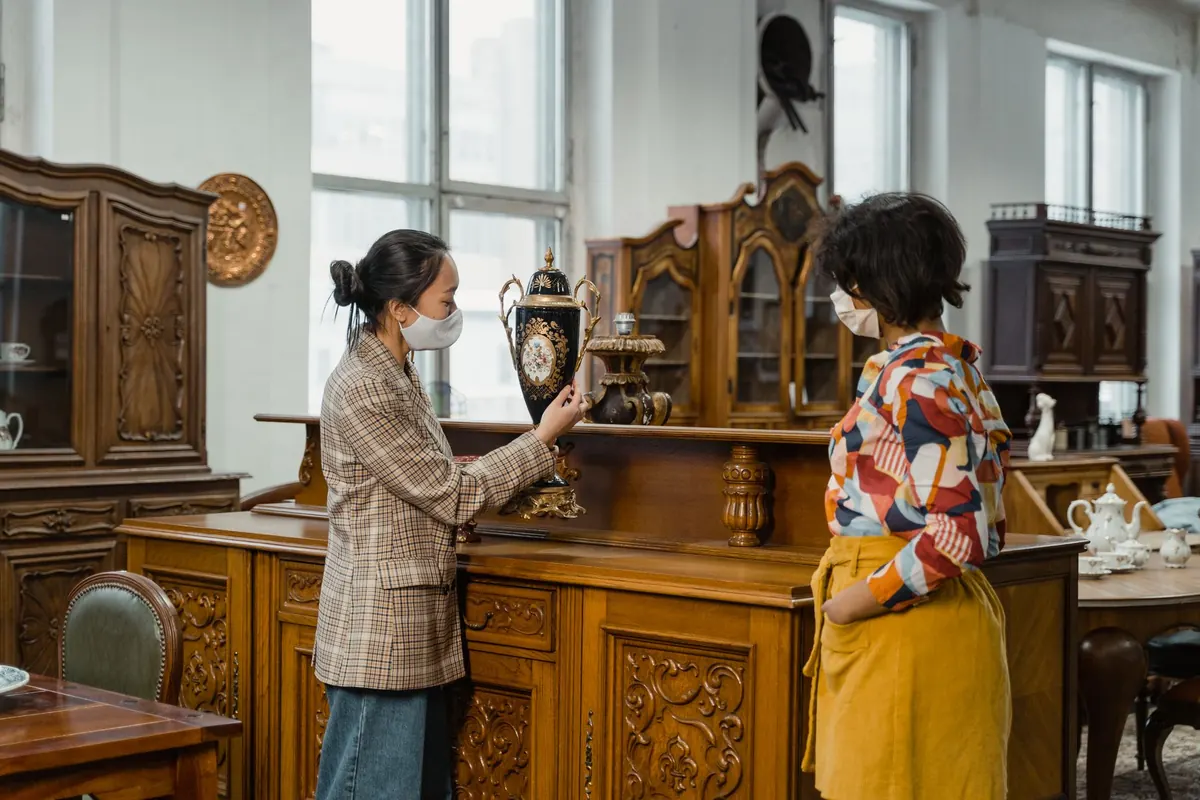
A good dealer can date a chest of drawers from the other side of a room, then spend five minutes with a torch proving it. That second part matters more than the first. Marks and labels are useful, but they are only one thread in the weave: joinery, hardware, timber movement and wear all have to agree before you can trust a piece — and your own eye.
Where Makers Left Their Marks
Makers stamped where they expected nobody to look. Take every drawer out. Check the top edge of the drawer sides, the back of the drawer front, the inside of the carcase, under seat rails and beneath table tops. Familiar marks include:
- Gillows of Lancaster and London — the name struck or stamped along a drawer edge, often alongside numbers repeated across the parts of a single piece so each drawer can be matched to its opening. Numbers that fail to correspond across a "set" deserve questions.
- Robert Thompson of Kilburn — no signature, just a carved mouse. It should sit on a structural edge, be softened by handling, and be cut in the same timber as the piece. A mouse in a different wood on a tired-looking chest is a warning.
- French work — a "JME" stamp under a crown on eighteenth-century pieces made for the Paris guild system.
- Institutional marks — "VR" under a crown, "W.D.", railway, Post Office and hospital stencils. These are usually honest histories rather than forgeries, though stencils are easy to add.
The vast majority of decent furniture was never signed at all. Provincial workshops rarely bothered. An unmarked piece with excellent joinery beats a stamped piece with sloppy work every time.
Labels, Plates and Royal Warrants
Paper labels turn up on the backboards of chests, under seat frames and inside cupboard doors: Heal & Son, Maple & Co, Waring & Gillow, Jas Shoolbred, Liberty, Shapland & Petter. The label ages with the piece. Expect foxing, brittle paper, lifting corners and old glue. A pristine, sharply printed label on a heavily knocked-about carcass is a contradiction worth noticing.
Royal warrants — "By Appointment" on a brass plate or printed label — tell you who sold the piece and when the association existed. They rarely tell you who made it. Department stores retailed their own work and other people's, so a label is evidence of a retailer, not a workshop.
Joinery: The Test That Is Hard to Fake
Look inside a drawer with a torch and at the back of the carcase. Hand-cut dovetails are irregular, and the spacing wanders because a craftsman marked them by eye. Machine-cut dovetails, common from the later nineteenth century and near-universal in the twentieth, are evenly spaced and identical. Deep, uniform pins with a perfect fit on a piece claiming to be Georgian is a problem.
Drawer bottoms are just as telling. Early examples were often a single board or two, running front to back, fitted into a rebate; plywood and thin machined board belong to the twentieth century. Hand-planed surfaces carry faint scallops from the plane; machine planing is dead flat. Circular saw marks, the shallow arcs left across a board, appear from the mid-nineteenth century. Straight pit-saw marks are much older.
Screws and nails as dating tools
Hand-made screws, broadly pre-1840s, are tapered and blunt with an off-centre slot and often incomplete threading. Machine-made screws with proper points took over afterwards. Phillips screws belong to the 1930s onwards. Cut nails dominate until late in the nineteenth century; wire nails follow. If a hinge is held by modern screws into clean, unworn timber, something has been changed — or made.
Wear Patterns and the Ghosts of Old Fittings
Honest wear appears where hands and floors meet furniture. Chair arms and front rails are rubbed pale; splats are shiny at the top; front feet and the bottom of back legs are scuffed and shortened. Drawer runners and drawer sides wear where they slide; a table top takes its damage at the edges.
Solid timber shrinks across the grain with age. Wide tops part slightly along their joints, panels rattle in their frames, and drawer fronts may sit proud of the carcase. Shrinkage cannot be faked convincingly, so treat it as one of your best allies.
Then look for ghosts. Where an old brass handle or backplate sat, you will find a darker or lighter shadow in the polish, old screw holes and sometimes a rectangle of unfaded timber. Handles moved from their original position mean restoration. That is fine, provided the seller says so.
Recognising Deliberate Fakery
Wear applied by hand is usually too tidy: uniform dulling along every edge, dents in corners nothing could have knocked, dark wax rubbed into places a hand would never reach. Genuine wear is uneven and follows use.
Other things to watch for:
- Marriages — a base and top from different pieces, hidden by matching polish. Check for a top whose overhang is uneven or timber that changes grain at the join.
- Added carving — new carving is crisp with sharp arrises and shows fresh, unoxidised timber inside the cuts; old carving is softened.
- Conversions — chests cut down, longcase trunks turned into cupboards, legs shortened to fit a modern ceiling.
- Backs as smart as fronts — a strong sign of twentieth-century manufacture, along with plywood, staples and PVA glue.
Remember the revival periods too. Late Victorian and Edwardian workshops produced quantities of "Chippendale" and "Sheraton" furniture, and the trade used those names long after the men were dead.
Where the Bargains Actually Are
The bargain is seldom a famous name at a knockdown figure. It is a well-made piece by a minor or unknown maker, bought fairly and sound in the frame. Provincial oak, elm, fruitwood and mahogany repay attention. So do large pieces — tallboys, chiffoniers, big Victorian dining tables — which stay cheap because they are awkward to house.
Cosmetic damage is your friend: a water ring, lifting veneer, a faded finish. Structural trouble is not. Walk away from twisted carcases, repaired leg joints, rot and active worm. Fresh frass, the fine powder beneath the holes, and crisp hole edges mean activity, not history.
One practical note: if you are considering anything valuable, or any piece using ivory, tortoiseshell or restricted timbers such as rosewood, take specialist advice before buying. UK rules on these materials are strict and change, and a reputable dealer or valuer will know what documentation is required.
A Quick Checklist Before You Buy
- Inspect in daylight, on all sides, including the back and underside.
- Remove every drawer and cupboard shelf; look at runners, dovetails and backboards.
- Check marks, labels and stamps against the joinery and timber of the piece.
- Test for movement: press a corner, lift a leg, twist gently. Racking is expensive.
- Compare the wear with how the piece would have been used.
- Ask what has been replaced, repaired or refinished, and get it in writing.
- Ask about provenance, then treat a good story as a story, not evidence.
- For anything serious, get a second opinion from someone who is not selling it to you.
Do the checks in that order and you will occasionally walk away from something you liked. You will also, far more often, buy with confidence — which is where the real pleasure of this hobby sits.
Photo: Tima Miroshnichenko / Pexels